
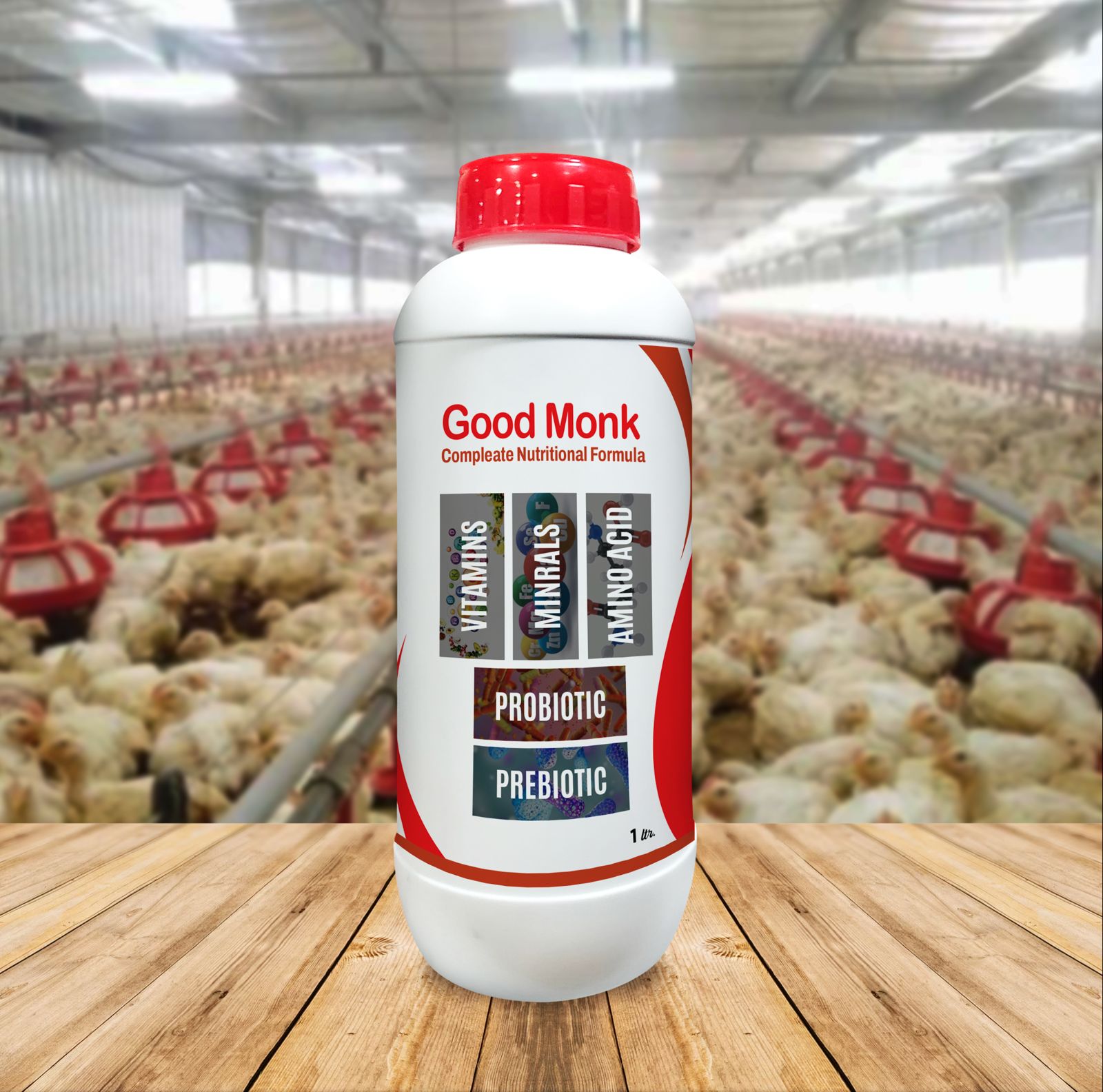
Good Monk ™
Complete Nutritional Formula
MINERALS:
• Calcium, phosphorus, and magnesium: Used for bone formation
• Sodium, potassium, and chlorine: Maintain electrolyte balance in cells
• Copper and zinc: Maintain feather colour
• Iodine: Necessary for thyroid hormone synthesis, which affects growth, egg production, and egg size
• Electrolytes: Help balance blood pH and replenish reserves
• Sodium, potassium, and chlorine: Maintain electrolyte balance in cells
• Copper and zinc: Maintain feather colour
• Iodine: Necessary for thyroid hormone synthesis, which affects growth, egg production, and egg size
• Electrolytes: Help balance blood pH and replenish reserves
PROBIOTIC:
Probiotics in poultry work in a number of ways to improve the health and performance of poultry, including:
• Gut health: Probiotics maintain a healthy balance of intestinal microflora, which can help prevent pathogen infections.
• Immune system: Probiotics can improve the immune response of poultry by stimulating the production of immune-modulating compounds and increasing the activity of immune cells. Fe Cr Mg Ca Zn Na Se F Cu Trace Minerals in Poultry
• Digestion: Probiotics can increase the activity of digestive enzymes, which can improve nutrient absorption and feed intake.
• Vitamin and mineral metabolism: Probiotics can help with the synthesis of vitamins and the metabolism of minerals, which are important for growth and metabolism.
• Nutrient absorption: Probiotics can protect epithelial barriers, which can improve nutrient absorption. Probiotics can also help to reduce nutritional requirements by improving the absorption of nitrogen and phosphorus.
• Gut health: Probiotics maintain a healthy balance of intestinal microflora, which can help prevent pathogen infections.
• Immune system: Probiotics can improve the immune response of poultry by stimulating the production of immune-modulating compounds and increasing the activity of immune cells. Fe Cr Mg Ca Zn Na Se F Cu Trace Minerals in Poultry
• Digestion: Probiotics can increase the activity of digestive enzymes, which can improve nutrient absorption and feed intake.
• Vitamin and mineral metabolism: Probiotics can help with the synthesis of vitamins and the metabolism of minerals, which are important for growth and metabolism.
• Nutrient absorption: Probiotics can protect epithelial barriers, which can improve nutrient absorption. Probiotics can also help to reduce nutritional requirements by improving the absorption of nitrogen and phosphorus.
PREBIOTIC:
Prebiotics are metabolized by bacteria in theGIT into organic molecules that the host can use. Most of the impact of prebiotics occurs in the lower parts of the GIT, particularly the ceca.
DEXTROSE:
• Nutrition & Health
- Energy
• Taste & Texture - Flavour Enhancer
• Formulation Benefits - Sweetener
• Taste & Texture - Flavour Enhancer
• Formulation Benefits - Sweetener
DOSAGE-LIQUID:
Chicks - 3 to 5 ml/100 chicks
Growers- 7 to 10 ml/100 birds
Layer/breeders - 12 to 15ml /100 birds.
Growers- 7 to 10 ml/100 birds
Layer/breeders - 12 to 15ml /100 birds.
DOSAGE-POWDER:
250gm to 500 gm/ton of feed.
VITAMINS:
• Vitamin A: Supports normal growth,
reproduction, and maintenance of epithelial cells
• Vitamin D3: Supports proper absorption and utilization of calcium and phosphorus
• Vitamin E: An antioxidant that supports normal neurological functions
• Vitamin K: Supports clotting mechanisms and protects against coccidiosis
• Vitamin C: Supports birds under stress
• Thiamine (Vitamin B1): Supports proper carbohydrate metabolism
• Riboflavin (Vitamin B2): Supports metabolism as part of enzyme systems
• Pyridoxine (Vitamin B6): Supports proper metabolism of amino acids
• Cyanocobalamin (Vitamin B12): Supports nucleic acid synthesis, carbohydrate and fat metabolism, and methyl synthesis
• Vitamin D3: Supports proper absorption and utilization of calcium and phosphorus
• Vitamin E: An antioxidant that supports normal neurological functions
• Vitamin K: Supports clotting mechanisms and protects against coccidiosis
• Vitamin C: Supports birds under stress
• Thiamine (Vitamin B1): Supports proper carbohydrate metabolism
• Riboflavin (Vitamin B2): Supports metabolism as part of enzyme systems
• Pyridoxine (Vitamin B6): Supports proper metabolism of amino acids
• Cyanocobalamin (Vitamin B12): Supports nucleic acid synthesis, carbohydrate and fat metabolism, and methyl synthesis
AMINO ACID:
Amino acids and vitamins are important for
poultry health and growth, and they work
together in a number of ways:
• Protein synthesis: Amino acids, especially essential ones like methionine, lysine, and threonine, are essential for building structural and functional proteins in poultry. The availability of these amino acids affects how quickly muscles develop and how well the poultry grows.
• Immune response: Amino acids, like arginine, methionine, and cysteine, help with the immune defence system, antioxidant system, cell signalling, and gene expression.
• Growth and development: Amino acids can help regulate growth and development in poultry.
•Stress: Vitamin C supplementation can help birds that are stressed.
• Metabolism: Vitamins like pyridoxine (vitamin B6) helps metabolize amino acids, while thiamine (vitamin B1) helps metabolize carbohydrates, and riboflavin (vitamin B2) is part of enzyme systems that help with metabolism.
• Bone development: Vitamin D3 helps the body absorb and use calcium and phosphorous, which are important for bone development.
• Neurological functions: Vitamin E helps with neurological functions and is an antioxidant.
• Clotting: Vitamin K helps with clotting mechanisms and protects against coccidiosis.
• Protein synthesis: Amino acids, especially essential ones like methionine, lysine, and threonine, are essential for building structural and functional proteins in poultry. The availability of these amino acids affects how quickly muscles develop and how well the poultry grows.
• Immune response: Amino acids, like arginine, methionine, and cysteine, help with the immune defence system, antioxidant system, cell signalling, and gene expression.
• Growth and development: Amino acids can help regulate growth and development in poultry.
•Stress: Vitamin C supplementation can help birds that are stressed.
• Metabolism: Vitamins like pyridoxine (vitamin B6) helps metabolize amino acids, while thiamine (vitamin B1) helps metabolize carbohydrates, and riboflavin (vitamin B2) is part of enzyme systems that help with metabolism.
• Bone development: Vitamin D3 helps the body absorb and use calcium and phosphorous, which are important for bone development.
• Neurological functions: Vitamin E helps with neurological functions and is an antioxidant.
• Clotting: Vitamin K helps with clotting mechanisms and protects against coccidiosis.
AVAILABLE
- Available in 1 liter HDPE bottle
- Available in Powder in 10 kg and 25 kg bag
- Available in Powder in 10 kg and 25 kg bag